


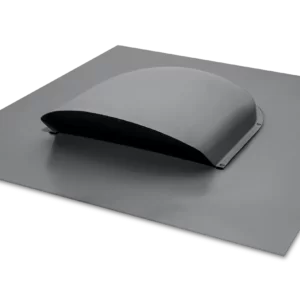
Let’s talk roof penetrations. If you’ve spent any time designing, building, or obsessing over residential airflow, you know that roof ventilation has historically been a compromise. For decades, we’ve been forced to disrupt clean architectural lines with bulky rotary turbines or complex, multi-part cowl assemblies just to let the building envelope breathe.
But the industry is shifting, and the Alpine Low Profile Roof Vent is driving a lot of that change. It’s an elegant piece of engineering that solves some of the most persistent headaches in roof cavity ventilation and HVAC ducting. Here is a breakdown of why this unit is quickly becoming the spec of choice over legacy competition.
- The Single-Unit Form Factor
Anyone who has installed a traditional rangehood or exhaust vent knows the drill: you’re wrestling with a steel pipe, dressing the lead or Dektite flashing, and then securing the cowl on top. It’s a three-piece puzzle that introduces multiple failure points for water ingress.
Alpine threw that entire playbook out. They engineered a patented, single-piece unit that integrates the flashing, neck, and protective dome.
- The Traditional Method: Time-consuming install, reliance on sealants, and a prominent, often ugly profile.
- The Alpine Approach: Drop it in, secure it, and you’re done. It drastically cuts down installation time and practically eliminates the risk of flashing leaks.
- Unlocking Solar Real Estate
If you’re mapping out a photovoltaic (PV) array, traditional vents are your worst enemy. They cause shading issues that can cripple a string inverter system, and they physically block prime north-facing roof space.
Because the Alpine sits nearly flush with the roofline, it can be installed directly underneath solar panels. For homeowners and installers trying to maximize a high-kW system on a limited roof footprint, this is an absolute game-changer. You no longer have to choose between a properly ventilated roof cavity and maximum solar yield.
- Passive Venting and the “Stack Effect”
Rotary vents (whirlybirds) are active—they need wind to spin, and they rely on internal bearings. As any seasoned tradesperson will tell you, those bearings inevitably degrade, seize, or start screeching.
Alpine opted for a static design that utilizes the natural stack effect and Bernoulli’s principle. Hot air rises and escapes, while ambient breezes across the low-profile dome create negative pressure, pulling stale air out of the cavity.
- Zero Mechanical Failure: No moving parts means no maintenance and zero noise.
- Consistent Draw: You aren’t waiting for a gust of wind to start moving air.
- BAL-40 Compliance and Weather Defense
In Australia, especially given our strict building codes regarding bushfire zones, what a vent keeps out is just as important as what it lets out. Cheap cowls are notorious for letting in wind-driven rain or becoming luxury apartments for local birds and rodents.
Alpine engineered their vents with an internal deflector and an overhanging lip that effectively baffles driving rain. More importantly for compliance, it features a 2mm aperture steel mesh. This makes the unit BAL-40 compliant right out of the box, offering serious defense against ember attacks and pest intrusion without choking the airflow.
- Architectural Invisibility
From a design perspective, the best roof vent is the one you don’t notice. Traditional cowls stick out like periscopes. Alpine vents are manufactured from high-grade, powder-coated aluminum and stainless steel, engineered to sit low and blend in.
They are color-matched to the Colorbond® steel range (Monument®, Surfmist®, Shale Grey™, etc.), making them visually disappear into a metal deck or tiled roof. They even offer a paintable variant, which is perfect when you’re dealing with custom heritage colors or specific terracotta tiles.
The Bottom Line
The Alpine Low Profile series represents exactly what we want to see in building materials: smart consolidation of parts, awareness of modern home tech (like solar), and bulletproof reliability. It’s not just a better looking vent; it’s a structurally superior approach to airflow. Alpine sells their products including the low profile roof vents across a wide network of resellers from Dahlsens, Bowens, Tradelink, Accord Air and many more.